The electric vehicle (EV) market is expanding at an unprecedented pace. Governments worldwide are introducing stricter emissions regulations, automakers are investing billions into electrification, and consumers are increasingly adopting electric mobility. As EV adoption grows, the demand for reliable, efficient, and standards-compliant EV charging infrastructure continues to rise.
Behind every successful EV charger is a rigorous testing process designed to ensure safety, interoperability, performance, and grid compatibility. This is where bidirectional grid simulators have become essential. Modern EV charger testing requires far more than simply supplying AC power. Engineers now need to replicate real-world grid conditions, evaluate bidirectional energy flow, simulate grid disturbances, and validate compliance with evolving standards such as V2G (Vehicle-to-Grid) and V2H (Vehicle-to-Home).
Bidirectional grid simulators accelerate EV charger testing by enabling faster development cycles, more accurate simulations, energy-efficient testing environments, and comprehensive validation of advanced charging technologies.
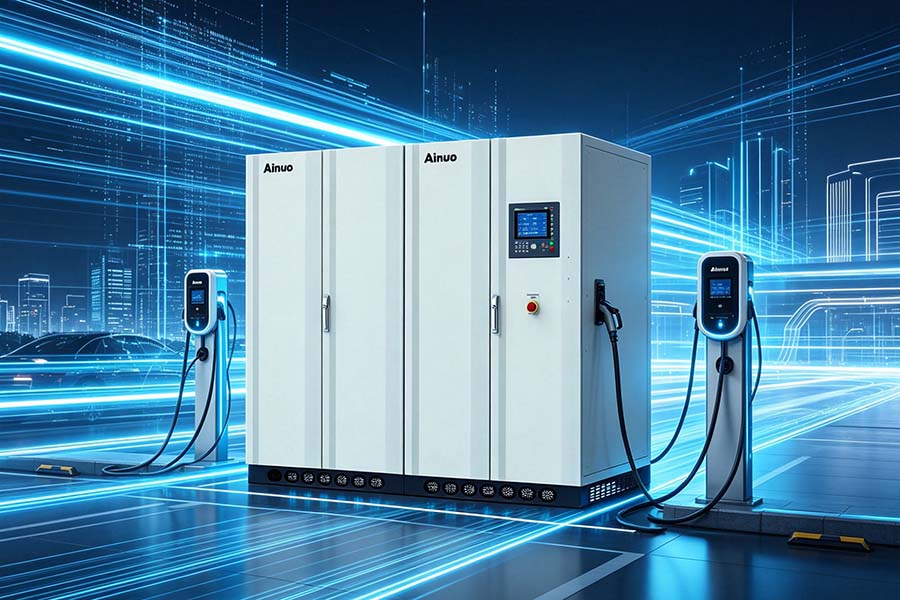
A bidirectional grid simulator is an advanced AC power source capable of both sourcing and sinking power. Unlike conventional AC sources that only provide power to the device under test, bidirectional systems can also absorb energy and return it to the electrical grid.
This regenerative capability is particularly important in EV charging applications because modern chargers and vehicle systems increasingly support two-way energy transfer. For example, in a V2G system, energy can flow from the EV battery back to the utility grid during peak demand periods.
Bidirectional grid simulators allow engineers to emulate:
Stable grid conditions
Voltage fluctuations
Frequency variations
Harmonic distortions
Grid faults
Power outages
Regenerative energy scenarios
These simulators create a controlled laboratory environment that closely mirrors real-world grid behavior, enabling manufacturers to validate charger performance before deployment.
EV chargers are no longer simple power conversion devices. Modern charging systems must communicate intelligently with vehicles, utility networks, energy management systems, and renewable energy installations.
Today’s charging systems often include:
Smart charging algorithms
Dynamic load balancing
Grid-support functions
Renewable energy integration
Battery energy storage interaction
Vehicle-to-grid functionality
Cybersecurity communication protocols
As complexity increases, testing requirements become significantly more demanding. Engineers must evaluate chargers under countless operating scenarios while ensuring compliance with regional and international standards.
Traditional testing methods can be slow, inefficient, and expensive. Bidirectional grid simulators address these challenges by enabling automated, programmable, and highly repeatable test environments.
One of the most significant advantages of bidirectional grid simulators is their ability to accelerate V2G testing.
Vehicle-to-grid technology allows EV batteries to return stored energy back to the grid. This capability transforms EVs into distributed energy resources that can support grid stability, peak shaving, and renewable energy balancing.
Testing V2G functionality requires the ability to simulate both energy delivery and energy absorption. Conventional AC sources struggle with these requirements because they cannot efficiently absorb returned power.
Bidirectional grid simulators solve this problem by enabling seamless two-way power flow testing. Engineers can validate:
Reverse power transfer
Grid synchronization
Power factor correction
Anti-islanding protection
Frequency regulation response
Demand response participation
This dramatically shortens validation cycles and reduces the need for complex external load equipment.
EV chargers must operate reliably even when grid conditions are unstable. Utilities and regulatory bodies require chargers to maintain safe operation during events such as:
Voltage sags
Voltage swells
Frequency deviations
Harmonic distortion
Phase imbalance
Short interruptions
Bidirectional grid simulators allow engineers to recreate these disturbances with high precision.
For example, an engineer can program a voltage dip event lasting only milliseconds to determine whether the charger maintains proper operation or safely disconnects from the grid. Similarly, frequency fluctuation testing helps verify compliance with regional utility standards.
Because these simulations are programmable and repeatable, engineers can automate testing procedures and identify failures much faster than with manual testing setups.
Regulatory compliance is one of the most time-consuming stages of EV charger development. Manufacturers must comply with multiple standards depending on target markets.
Common standards include:
IEC 61851
ISO 15118
UL 1741
IEEE 1547
CHAdeMO protocols
CCS charging standards
Bidirectional grid simulators streamline compliance testing by enabling automated execution of required test sequences.
Instead of manually configuring multiple pieces of equipment, engineers can use a single programmable platform to simulate:
Grid transients
Frequency shifts
Harmonic injection
Fault ride-through conditions
Reactive power behavior
Automation reduces setup time, minimizes human error, and accelerates certification readiness.
Traditional power testing systems waste enormous amounts of energy as heat. During EV charger testing, especially at high power levels, dissipating returned energy requires large resistive loads and cooling systems.
Bidirectional grid simulators eliminate this inefficiency through regenerative operation.
When the charger or EV system returns energy during testing, the simulator sends that power back to the facility grid instead of converting it into heat. This offers several major benefits:
Reduced electricity costs
Lower cooling requirements
Smaller HVAC infrastructure
Improved laboratory sustainability
Reduced operational expenses
For high-power DC fast charger manufacturers, energy savings can be substantial over time.
The rise of ultra-fast DC charging has created new engineering challenges. Chargers delivering 150 kW, 350 kW, or even higher power levels require extensive testing under demanding electrical conditions.
Bidirectional grid simulators provide the precision and scalability needed for high-power charger development.
Engineers can test:
High transient loads
Rapid power changes
Thermal stress conditions
Grid interaction behavior
Efficiency optimization
Dynamic charging profiles
Because these systems are programmable, developers can simulate real-world charging scenarios without relying on actual utility grid disturbances.
This accelerates product development while improving charger reliability and performance.
Modern EV charger development depends heavily on automated testing. Manual testing processes are too slow and inconsistent to keep up with rapid product iteration cycles.
Bidirectional grid simulators integrate with automated test platforms and software environments, enabling engineers to run comprehensive validation sequences with minimal intervention.
Automation capabilities include:
Scripted test routines
Remote operation
Data logging
Real-time waveform analysis
Pass/fail reporting
Long-duration endurance testing
Repeatable testing ensures that engineers can reproduce failures consistently, making debugging and design optimization significantly faster.
Many EV charging stations are now integrated with renewable energy systems such as solar arrays and battery storage systems.
This creates additional testing complexity because charging systems must interact dynamically with distributed energy resources.
Bidirectional grid simulators help engineers validate charger behavior in renewable energy environments by simulating:
Solar generation variability
Battery storage interaction
Microgrid operation
Grid instability
Load balancing scenarios
This capability is especially important as smart charging infrastructure becomes more tightly integrated with renewable energy ecosystems.
Traditional EV charger testing setups often require multiple devices, including:
AC power sources
Electronic loads
Harmonic generators
Grid disturbance simulators
Regenerative systems
Bidirectional grid simulators consolidate many of these functions into a single platform.
This reduces:
Laboratory footprint
System complexity
Equipment maintenance
Integration challenges
Initial capital investment
Engineers can perform more tests using fewer devices, leading to faster setup times and simplified workflows.
The future of EV charging extends beyond simple battery replenishment. Emerging technologies include:
Bidirectional charging
Smart grid participation
Wireless charging
Autonomous charging systems
Dynamic load management
AI-driven energy optimization
Testing these advanced systems requires flexible and programmable simulation tools capable of evolving alongside industry innovation.
Bidirectional grid simulators provide the adaptability needed to support future charging architectures and evolving regulatory requirements.
Their software-defined nature allows manufacturers to update testing capabilities as standards and technologies change.
Consider an EV charger manufacturer developing a new 350 kW ultra-fast charger with V2G capability.
Using conventional testing methods, engineers may need separate systems for:
AC grid emulation
Energy dissipation
Harmonic testing
Fault simulation
Power quality analysis
Setting up and coordinating these systems can consume weeks of engineering effort.
With a bidirectional grid simulator, the manufacturer can integrate these functions into a single automated test environment. Engineers can rapidly execute hundreds of test scenarios, including regenerative energy flow conditions, without excessive energy waste.
As a result, the company can:
Shorten development timelines
Reduce certification delays
Improve product reliability
Lower testing costs
Accelerate time-to-market
In a highly competitive EV industry, these advantages are critical.
As EV charging technology evolves, testing requirements are becoming more sophisticated and demanding. Manufacturers must validate not only charger performance but also grid interaction, energy regeneration, renewable energy compatibility, and advanced smart charging functions.
Bidirectional grid simulators have emerged as a vital tool for accelerating EV charger testing. Their ability to source and absorb power, emulate real-world grid conditions, automate complex test procedures, and regenerate energy makes them indispensable for modern power electronics development.
By enabling faster validation, improved energy efficiency, enhanced automation, and comprehensive compliance testing, bidirectional grid simulators help EV charger manufacturers bring safer, smarter, and more reliable products to market faster than ever before.
As the future of transportation becomes increasingly electrified, the role of bidirectional grid simulation technology will only continue to grow.
*Please fill in the required information carefully, and we will contact you within 4-8 hours.

 TEL:+86 532 83995188
 PHONE:+86 177 5322 5039
 E-MAIL:ainuo@ainuo.com
 ADDRESS:No. 134 Zhuzhou Rd, Laoshan District, Qingdao, China


Copyright©2025. Aino Instrument Co., Ltd All Rights Reserved.
Powered by:WDL