The rise of electric vehicles (EVs) has ignited a monumental shift in the automotive and energy industries. With this evolution comes an equally intense focus on testing, validation, and performance optimization. One of the most indispensable tools in the EV testing ecosystem is the high-power DC electronic load. These devices might not grab headlines like new battery chemistries or fast-charging technologies, but they play a crucial and often misunderstood role in ensuring EV systems are safe, efficient, and ready for millions of miles of real-world use.
In this post, we'll dive into what a high-power DC electronic load is, how it operates, and the many critical functions it serves in modern EV testing. We'll explore specific use cases, testing strategies, and why this class of equipment is indispensable for vehicle manufacturers, battery developers, and test engineers around the world.
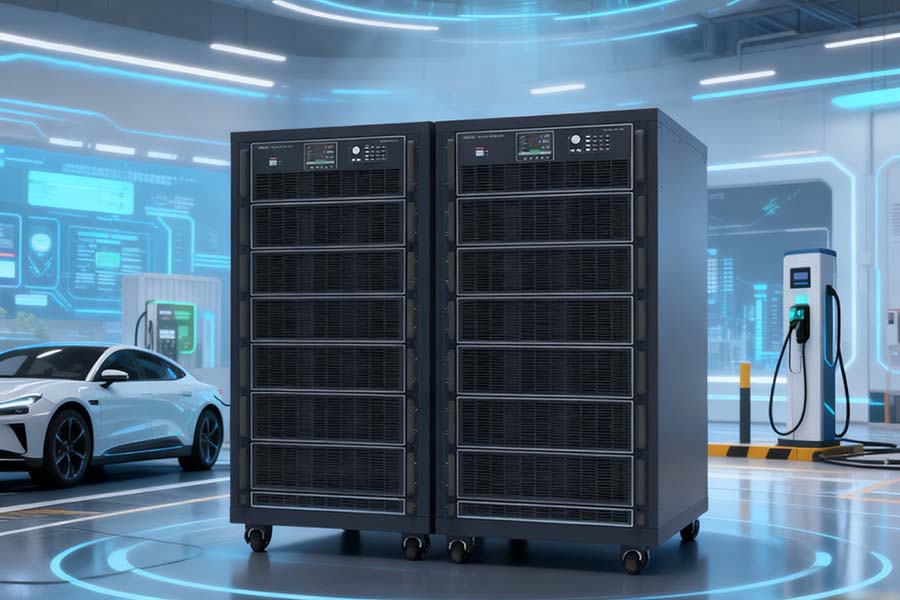
At its core, a DC electronic load is a programmable device that draws power from a DC source to simulate the behavior of real electrical loads. When we add "high power" to the description, we mean equipment capable of dissipating hundreds to thousands of watts, or even tens of kilowatts of electrical energy, safely and controllably.
Unlike a simple resistor, an electronic load can dynamically change how it consumes power based on voltage, current, and time profiles. It can emulate constant current (CC), constant voltage (CV), constant power (CP), or more complex patterns. In EV contexts — where components and systems experience widely varying electrical stresses — this programmability is key.
Electric vehicles aren't just mobile devices — they are powerful electrical systems. Modern EV batteries can deliver hundreds of kilowatts of power. Motors, inverters, and onboard electronics regularly push and pull large amounts of current. Testing these systems with low-power equipment simply isn’t feasible.
A high-power DC electronic load can:
Simulate real driving conditions by drawing varying loads that mimic acceleration patterns, regenerative braking events, auxiliary loads, and more.
Test at full system capacity, ensuring hardware behaves correctly under peak demands.
Handle rapid transitions between load states without damage, reflecting the dynamic behavior of EV electrical systems.
Let's explore the major ways high-power DC electronic loads are used throughout the EV testing pipeline.
One of the most fundamental uses of DC electronic loads is in battery discharge characterization.
What This Involves:
Charging a battery pack to a known state of charge (SOC)
Applying controlled loads to draw current from the pack
Measuring voltage, temperature, and other parameters over time
Why It Matters:
Understanding how a battery behaves during discharge helps engineers determine:
Capacity (Ah and Wh ratings)
Voltage stability under load
Thermal behavior
Performance degradation over cycles
High-power DC loads allow testing at real-world currents. For example, a 400 V EV battery under a 200 A load corresponds to 80 kW — easily beyond the range of simple lab power supplies.
Fast charging is a hallmark of modern EVs. But replicating these conditions in a test environment is complex.
The Challenge:
Fast chargers supply high voltage and high current profiles with dynamic behavior.
Battery packs see rapid state changes and thermal impacts.
How Electronic Loads Help:
Instead of bringing actual chargers into the lab (which can be expensive and unwieldy), engineers use high-power DC loads to:
Absorb excess energy when testing charging systems
Simulate the battery for charger validation
Stress test EVSE (Electric Vehicle Supply Equipment) to measure stability and compliance
Electronic loads can replicate charge patterns with precision, helping teams analyze how vehicles accept power and how charging stations respond.
Regenerative braking converts kinetic energy back into electrical energy — a powerful feature of EVs.When an EV uses regen braking, energy flows back into the battery or into intermediate storage circuits. However, for engineering and safety evaluation, this needs to be properly controlled.
High-power DC loads help by:
Absorbing regenerated power when the system must dump it during bench tests
Testing how the battery or converter responds to a rapid energy influx
Validating management systems that switch between charging, discharging, and load modes
Without high-power DC loads, engineers would struggle to accurately test regenerative systems at high energy levels.
Electric motors and inverters are core components of the EV drivetrain. To validate these systems, engineers often need to apply controlled loads to:
Test torque and power delivery profiles
Validate efficiency maps
Identify thermal and electrical limits
High-power DC loads provide an effective way to absorb energy in test cells where actual mechanical loads (like dynos) may not be appropriate or convenient.
EV systems integrate many components: HV battery, DC-DC converter, onboard charger, accessories, and control units. High-power DC electronic loads can be integrated into system-level test setups to:
Evaluate power distribution effectiveness
Validate safety systems during fault conditions
Perform end-of-line testing during manufacturing
For example, during an HV battery pack production run, each unit might be briefly discharged under load to check performance and consistency. High-power DC loads allow quick, reproducible testing.
Not all DC loads are created equal. EV testing puts specific demands on equipment, which leads to unique feature requirements:
Being able to define custom load vs. time curves means engineers can mimic:
Urban driving patterns
Highway cruising
Stop-start traffic
Aggressive acceleration
This is critical for understanding how systems perform in diverse conditions.
Most high-power DC loads support:
Constant Current (CC) — draw a fixed current
Constant Voltage (CV) — hold voltage while drawing whatever current is needed
Constant Power (CP) — maintain a power draw, useful for charger testing
Dynamic Mode — change modes rapidly according to a test script
This flexibility ensures loads can emulate different real-world behaviors.
In EV testing, data is king. Loads often interface with test benches, DAQ systems, and automated control frameworks so that:
Tests can run without human intervention
Data can be logged, analyzed, and compared across builds
Failures and anomalies can be quickly diagnosed
At high power levels, waste heat can be tremendous. Loads must:
Manage internal temperature effectively
Offer liquid cooling or advanced air cooling
Maintain stable performance during extended tests
Without this, the load itself becomes a point of failure.
Some might ask: why not just use resistors?
Electronic loads allow exact control of current and power, whereas resistors are fixed and inflexible.
Resistors cannot simulate fast changes in load. Electronic loads can - in microseconds.
High-power resistors can overheat and are less safe. Modern electronic loads have protections built in (overcurrent, overtemperature, overvoltage).
Resistors can't be "programmed". Electronic loads can follow scripts to generate complex test profiles.
While powerful and versatile, high-power DC electronic loads aren't plug-and-play. Engineers must consider:
High power means heat - and often, liquid cooling systems are needed for long test durations.
Integration with control systems requires planning, cabling, and safety interlocks.
High-power loads represent a significant investment, but one with strong ROI when you consider test accuracy, speed, and repeatability.
As EV technology continues to evolve - with faster charging, higher-capacity batteries, solid-state chemistries, and more electrified systems - the demands on testing equipment will grow too. We can anticipate:
Even higher power ratings for next-gen battery packs and chargers
Smarter loads with machine learning-assisted test profiling
Distributed test systems that integrate loads into digital twins and simulation frameworks
In other words, high-power DC electronic loads will become more than measurement tools - they will be integral parts of digital-physical co-design systems that accelerate EV development cycles.
Electric vehicles represent a complex interplay of electrical, mechanical, thermal, and software systems. To ensure these vehicles perform safely, efficiently, and reliably, engineers must simulate a vast range of real-world conditions in the lab.
High-power DC electronic loads provide a controlled, programmable, and robust way to simulate electrical behavior that batteries, motors, chargers, and vehicle systems will experience in real life. From battery characterization and fast charge testing to system integration and regenerative braking validation, these devices are an essential part of the modern EV test engineer’s toolkit.
*Please fill in the required information carefully, and we will contact you within 4-8 hours.

 TEL:+86 532 83995188
 PHONE:+86 177 5322 5039
 E-MAIL:ainuo@ainuo.com
 ADDRESS:No. 134 Zhuzhou Rd, Laoshan District, Qingdao, China


Copyright©2025. Aino Instrument Co., Ltd All Rights Reserved.
Powered by:WDL