Introduction
In today’s competitive manufacturing environment, product quality and electrical safety are essential to building customer trust and meeting regulatory requirements. For manufacturers of household appliances such as washing machines, refrigerators, microwave ovens, and electric kettles, ensuring electrical safety before products leave the factory is a critical part of quality control.
An
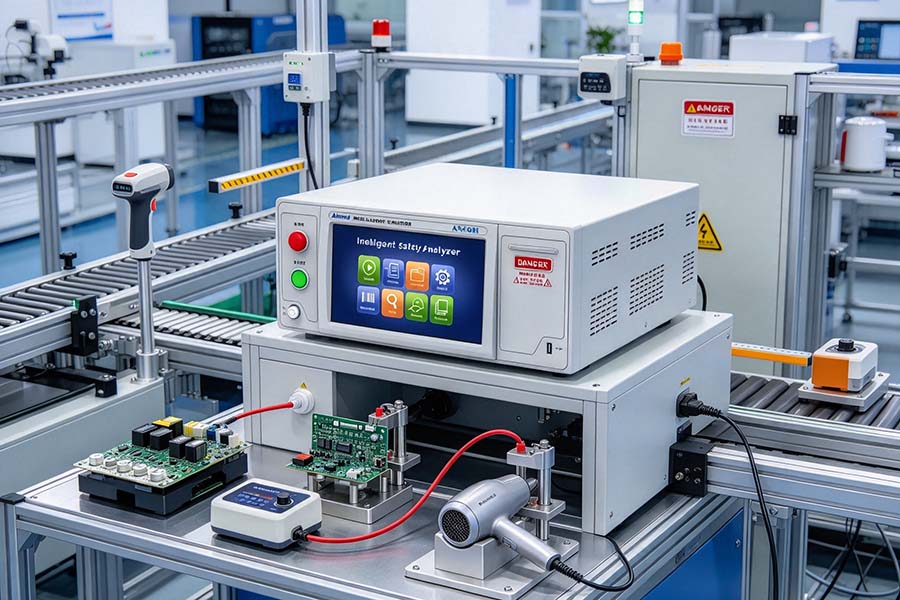
electrical safety tester helps manufacturers identify potential electrical hazards, verify product safety, and maintain consistent testing procedures throughout production. By integrating electrical safety testing into the production line, manufacturers can improve test repeatability, reduce manual errors, and maintain reliable quality records.
This article explores how electrical safety testers improve quality control, which testing functions matter most, and how automated testing solutions can support modern appliance manufacturing.
1. Why Electrical Safety Testing Matters in Appliance Manufacturing
Electrical appliances can pose safety risks if insulation is damaged, grounding is inadequate, or leakage current exceeds acceptable limits. These issues may lead to electric shock, equipment damage, or other hazards during product use.
Performing electrical safety tests during manufacturing helps identify defects before products reach customers. It also supports consistent production quality and helps manufacturers demonstrate compliance with applicable product safety requirements.
Depending on the appliance design and relevant standards, electrical safety testing may include:
Ground continuity testing: Verifies the integrity of the protective earth connection in applicable Class I appliances.
Insulation resistance testing: Evaluates the resistance of insulation between specified conductive parts.
Dielectric withstand (hipot) testing: Checks whether insulation can withstand a specified test voltage without unacceptable breakdown or current flow.
Leakage current testing: Measures current under defined test conditions to assess electrical safety.
Functional testing: Confirms that the appliance operates as intended, complementing electrical safety tests.
The required tests and acceptance limits depend on the appliance type, insulation system, applicable standards, and manufacturer’s test procedure.
2. Improving Test Consistency and Repeatability
Manual testing can introduce variability when operators use different procedures, select incorrect test settings, or record results inconsistently. Such variation makes it harder to compare results across production shifts and manufacturing sites.
Modern electrical safety testers can standardize testing through predefined test sequences, controlled parameters, and automatic pass/fail evaluation.
For example, a manufacturer may configure a tester to perform protective conductor continuity, insulation resistance, and dielectric withstand tests in a specified sequence. The instrument then evaluates each result against the programmed acceptance limits.
This approach helps manufacturers:
Standardize testing procedures across production stations.
Reduce operator-dependent variation.
Minimize incorrect test settings and recording errors.
Improve consistency between production batches.
Identify recurring quality issues more quickly.
Repeatability still depends on appropriate test fixtures, instrument performance, calibration, and consistent test conditions.
3. Increasing Production Efficiency Through Automated Testing
Production lines must balance testing accuracy with manufacturing throughput. When every appliance requires several electrical safety checks, inefficient manual workflows can create bottlenecks.
Automated electrical safety testers can help streamline these processes by combining multiple tests into one programmed sequence. Depending on the system, operators may initiate the sequence with a single action, while the instrument automatically advances through the required steps and displays the overall result.
Key features that can improve production efficiency include:
Programmable test sequences: Operators can select a product-specific program instead of manually configuring each test.
Automatic pass/fail evaluation: Results are compared against predefined limits, reducing subjective interpretation.
Fast test execution: Optimized sequences can reduce unnecessary setup and transition time while preserving the required test conditions.
Production system integration: Supported interfaces can connect the tester to a programmable logic controller (PLC), manufacturing execution system (MES), or other production equipment.
Clear result indicators: Visual or audible status signals help operators identify failed units and take appropriate action.
Automation should be validated against the manufacturer’s test requirements. Shortening test duration must never compromise the validity or safety of the test.
4. Reducing Human Error With Standardized Test Procedures
Human error is a common concern in repetitive manufacturing operations. An operator may select the wrong product profile, overlook a failed measurement, connect a test lead incorrectly, or enter a result into the wrong record.
Electrical safety testers with programmable settings and guided workflows can help address these risks.
Useful functions may include:
Product-specific test programs.
Automatic test progression and result evaluation.
Clear failure indications.
Barcode or QR-code scanning to identify the product under test.
User access controls and test-setting protection.
Interlocks and safety features appropriate to high-voltage testing.
For example, scanning an appliance’s barcode can help the production system select the corresponding test program and associate the results with the correct product record, provided the system is configured to support this workflow.
These functions help improve procedural consistency and reduce the likelihood of preventable testing mistakes.
5. Strengthening Traceability and Quality Data Management
Traceability is important for manufacturers that need to investigate defects, monitor production performance, or demonstrate that required testing has been completed.
Electrical safety testers equipped with data logging or external communication capabilities can record relevant information, such as:
Product serial number or barcode.
Test date and time.
Test parameters and measured results.
Pass/fail status.
Tester identification.
Operator or production station identification, where supported.
When integrated with a factory database or MES, these records can be used to identify recurring failures, compare production batches, and investigate quality complaints.
For example, if multiple appliances fail an insulation resistance test, engineers can review the associated records to determine whether the failures are concentrated in a particular production batch, assembly station, or component supplier.
Reliable traceability requires correct system configuration, data validation, appropriate access controls, and a defined record-retention policy. Data logging alone does not guarantee compliance.
6. Detecting Defects Earlier and Reducing Rework
Finding an electrical defect after an appliance has been fully assembled, packaged, or shipped can be expensive. Early detection allows manufacturers to isolate defective units before additional production resources are invested.
Integrating electrical safety testing at suitable points in the manufacturing process can help identify problems such as:
Damaged insulation caused during assembly.
Loose or improperly connected protective earth conductors.
Wiring errors.
Incorrectly installed electrical components.
Insulation failures associated with manufacturing defects.
Test placement should reflect the product design and manufacturing process. Some checks may be appropriate before final assembly, while others must be performed on the completed appliance.
When a unit fails, the production workflow should direct it to a controlled rework or investigation process. After corrective action, the required tests should be repeated according to the manufacturer’s documented procedure.
This approach helps prevent defective products from progressing through the production line and supports continuous improvement.
7. Choosing the Right Electrical Safety Tester for Your Production Line
Selecting the appropriate tester requires more than comparing specifications or purchase prices. Manufacturers should evaluate how the instrument will operate within their actual production environment.
Consider the following factors:
1. Required test functions
Determine whether the appliance requires ground continuity, insulation resistance, dielectric withstand, leakage current, or other tests. Confirm that the instrument supports the necessary methods and ranges.
2. Test voltage and measurement ranges
Verify that the tester supports the voltage, current, resistance, and measurement accuracy required by the relevant product standards and internal procedures.
3. Automation capabilities
Look for programmable sequences, automatic result evaluation, remote control, and supported PLC or production-system interfaces when integration is required.
4. Data logging and traceability
Assess whether the tester can store results locally or transfer them to a computer, database, or MES. Confirm that the available data fields meet your traceability requirements.
5. Operator safety
For dielectric withstand and other potentially hazardous tests, evaluate protective interlocks, emergency-stop arrangements, warning indicators, discharge provisions, and the overall test-station design.
6. Calibration and maintenance
Consider calibration requirements, service availability, verification procedures, and the impact of instrument downtime on production.
7. Product range and scalability
If the production line handles multiple appliance models, ensure that the tester can accommodate the required test programs and anticipated production changes.
A well-matched tester should satisfy the technical requirements while fitting the line’s throughput, traceability, safety, and maintenance needs.
8. Best Practices for Integrating Electrical Safety Testing Into Production
To get the most value from an electrical safety tester, manufacturers should establish a documented testing process.
Recommended practices include:
Define test requirements: Identify the applicable product standards, required tests, acceptance limits, and test conditions.
Create approved test programs: Configure and verify the appropriate settings for each appliance model.
Train production operators: Ensure personnel understand connections, operating procedures, failure handling, and safety precautions.
Validate the test station: Confirm that fixtures, connections, software, and test sequences work as intended.
Maintain calibration and verification schedules: Keep measurement equipment within its required performance limits.
Monitor failure trends: Review test data to identify recurring defects and process weaknesses.
Establish a failure-handling process: Prevent failed products from being released until the required investigation and corrective actions are complete.
Review the process regularly: Update test programs and documentation when products, components, standards, or manufacturing processes change.
Electrical safety testing should form part of a broader quality management system, alongside incoming inspection, process controls, functional testing, and final product inspection.
Conclusion
Electrical safety testers play an important role in improving quality control on appliance production lines. By standardizing test procedures, supporting automation, reducing operator-dependent errors, and enabling traceable test records, they help manufacturers build more consistent and reliable production processes.
Choosing the right tester requires careful consideration of test functions, measurement requirements, automation capabilities, data integration, operator safety, and maintenance needs.
For appliance manufacturers seeking to improve production quality and efficiency, investing in a suitable electrical safety testing solution can strengthen defect detection, support compliance activities, and provide better visibility into manufacturing performance.
Looking to optimize your appliance production line? Explore electrical safety testers with the test functions, automation options, and data management capabilities that match your manufacturing requirements. Consult the equipment manufacturer to confirm suitability for your specific products and test procedures.



 TEL:+86 532 83995188
 PHONE:+86 177 5322 5039
 E-MAIL:ainuo@ainuo.com
 ADDRESS:No. 134 Zhuzhou Rd, Laoshan District, Qingdao, China