As the electric vehicle (EV) industry expands, demand for reliable, high-performance EV charging infrastructure is growing rapidly. Before they reach the market, charging pile manufacturers must ensure their products operate safely, consistently, and reliably under different power supply conditions.
However, traditional manual testing methods can be time-consuming, difficult to reproduce, and inefficient when evaluating multiple operating conditions. This is where automated EV charging pile testing becomes increasingly important.
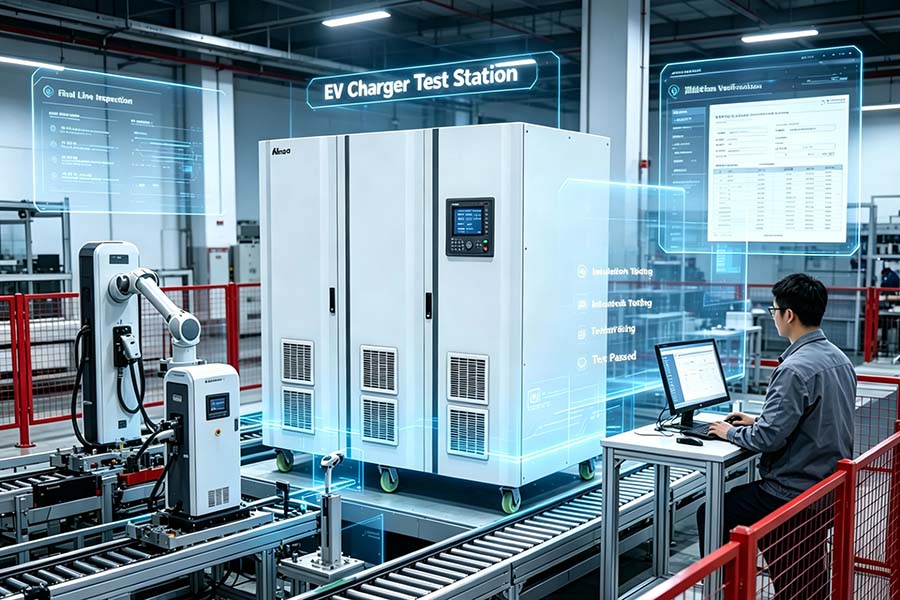
By integrating programmable AC power supplies into testing platforms, manufacturers and testing laboratories can simulate different grid conditions, execute predefined test sequences, monitor electrical parameters, and improve testing efficiency.
In this article, we explore how programmable AC power supplies support automated EV charging pile testing, the key functions to consider when selecting testing equipment, and how Ainuo’s ANFP(F) Programmable High-Power AC Power Supply can contribute to a comprehensive charging pile testing solution.
EV charging piles operate in different electrical environments. Variations in grid voltage, frequency, phase balance, and power quality can influence charging equipment performance.
To ensure product reliability, manufacturers need to evaluate charging piles under both normal and abnormal power supply conditions.
Common testing requirements include:
Voltage variation testing: Evaluating charging pile performance when the input voltage changes.
Frequency variation testing: Checking equipment stability under different power supply frequencies.
Three-phase imbalance testing: Simulating unbalanced three-phase power conditions.
Harmonic testing: Assessing equipment behavior when the supply voltage contains harmonic components.
Transient response testing: Evaluating equipment response to sudden electrical changes and impact loads.
Electrical parameter measurement: Monitoring voltage, current, frequency, active power, apparent power, and power factor.
Performing these tests manually can require considerable operator involvement. Automated testing helps standardize test procedures, reduce repetitive operations, and improve the consistency of test results.
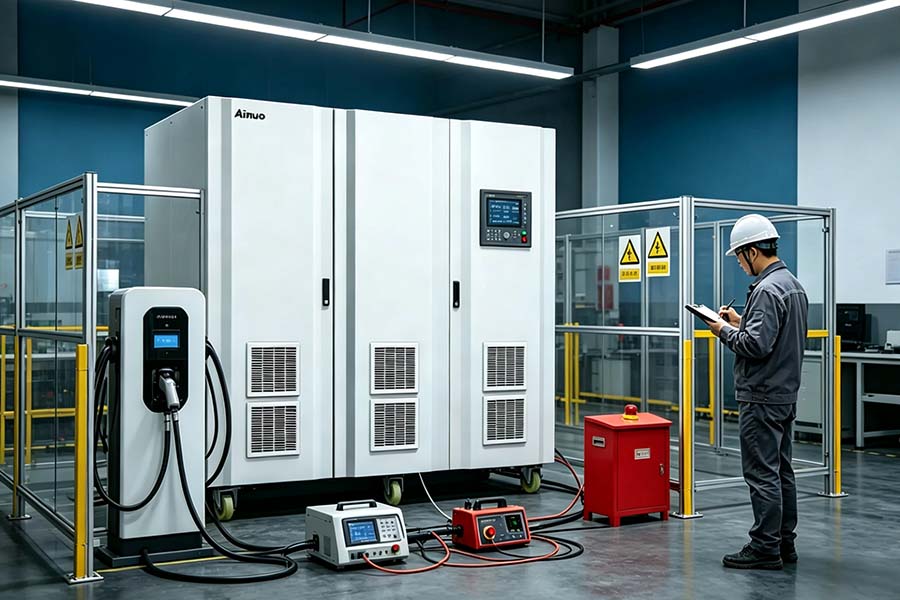
A programmable AC power supply is an important component of an EV charging pile testing platform. It provides a controllable AC power source that allows engineers to reproduce different electrical supply conditions.
Unlike conventional power sources, programmable AC power supplies allow users to adjust output parameters and configure test sequences according to specific testing requirements.
Here are four major ways they improve automated testing.
Voltage and frequency fluctuations are common power supply conditions that charging equipment may encounter.
During testing, engineers need to determine whether an EV charging pile can maintain stable operation when the input voltage or frequency changes.
A programmable AC power supply makes it possible to configure different voltage and frequency values, as well as execute stepwise or gradual variations.
These functions help engineers:
Evaluate charging equipment under different input voltage conditions.
Simulate power supply frequency fluctuations.
Perform voltage and frequency transition tests.
Observe equipment responses to programmed electrical changes.
With programmable output functions, engineers can establish repeatable test sequences instead of manually adjusting power supply parameters for every test.
Three-phase power imbalance can occur in electrical distribution systems and may affect the operation of three-phase charging equipment.
Testing under unbalanced conditions helps engineers understand how charging piles respond to differences in phase voltage and phase angle.
A programmable AC power supply with independent three-phase adjustment allows users to simulate different imbalance conditions.
For example, engineers can configure:
Different voltage amplitudes for individual phases.
Different phase angles.
Independent phase voltage and frequency settings, where supported.
Standard balanced and unbalanced three-phase output modes.
These capabilities make it easier to reproduce complex power supply conditions and evaluate equipment performance under controlled test environments.
Power quality is another important consideration in EV charging pile testing.
Harmonic distortion can influence electrical equipment operation and measurement accuracy. Therefore, engineers may need to evaluate charging equipment under power supply conditions containing harmonic components.
A programmable AC power supply with harmonic generation capabilities can superimpose harmonic components onto the fundamental waveform.
This allows testing laboratories to:
Simulate distorted AC voltage waveforms.
Evaluate charging equipment responses to harmonic interference.
Investigate the influence of harmonic components on electrical performance.
Conduct repeatable power quality-related tests.
For more comprehensive testing, engineers should select a power supply that supports the required harmonic orders and amplitude settings.
One of the biggest advantages of programmable AC power supplies is their ability to execute predefined test procedures.
Instead of manually changing output settings, engineers can configure test sequences involving multiple voltage levels, frequency settings, and operating stages.
Depending on the equipment configuration, remote communication interfaces and PC control software can also support centralized test operation.
This helps testing laboratories:
Reduce repetitive manual operations.
Improve test procedure consistency.
Execute complex test sequences more efficiently.
Integrate programmable power sources into automated test platforms.
Simplify test data collection and analysis.
Automated control is particularly valuable for manufacturers conducting repeated product validation and quality inspection.
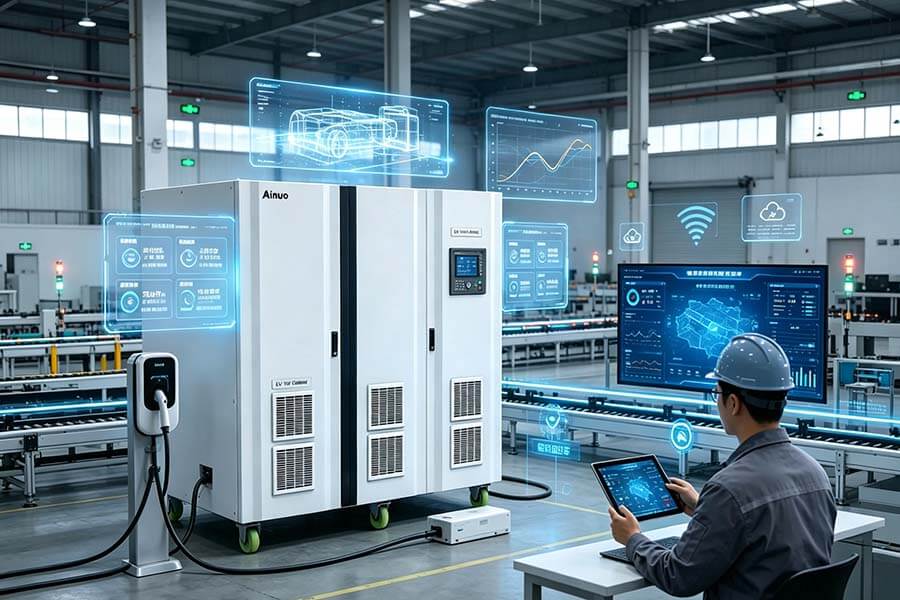
Selecting the right AC power supply is essential when building an automated EV charging pile testing platform.
The following features deserve particular attention.
Charging equipment testing may require substantial power capacity, especially when evaluating high-power equipment.
A high-power programmable AC power supply provides the output capability needed for demanding laboratory applications.
When selecting equipment, consider the required voltage, current, power capacity, and three-phase configuration.
Accurate and stable AC output is important for obtaining reliable test results.
Look for equipment using advanced digital control technologies that can provide precise voltage regulation and high-quality sine wave output.
Different charging pile testing scenarios require different power supply configurations.
Useful functions include:
Standard three-phase output.
Three-phase unbalanced output.
Independent three-phase output.
Parallel single-phase output.
These modes allow engineers to configure the power source according to their testing requirements.
Step, stage, and gradual-change output functions are useful for simulating changing grid conditions.
They also help automate repetitive tests and improve testing efficiency.
Integrated measurement capabilities can simplify the monitoring of electrical parameters during testing.
Important parameters include:
Voltage and current.
Current peak.
Frequency.
Active power and apparent power.
Power factor.
Voltage peak factor.
Online equipment monitoring and automatic operating data recording can also help improve laboratory operation and maintenance.
For automated test systems, remote communication is an important consideration.
Interfaces such as RS232, RS485, GPIB, Ethernet, and analog control can help integrate programmable AC power supplies with external control systems, depending on the available configuration.
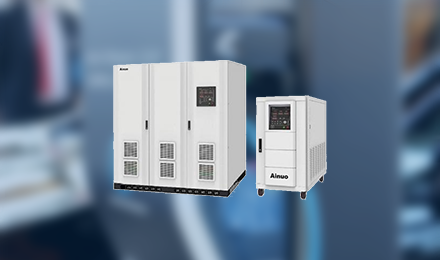
For laboratories and manufacturers looking for a high-power AC source for automated electrical testing, Ainuo offers the ANFP(F) Programmable High Power AC Power Supply.
The ANFP(F) series uses FPGA digital control, instantaneous waveform control, and high-frequency SPWM technology to provide high output accuracy, fast response, and high-quality sine wave output.
Its programmable functions and flexible output modes make it suitable for various electrical equipment testing applications, including relevant EV charging equipment input power simulation and validation.
Key features include:
1. Flexible Three-Phase Output Modes
The ANFP(F) supports standard three-phase output, three-phase unbalanced output, three-phase independent output, and parallel single-phase output.
Its three-phase unbalanced mode allows independent voltage adjustment, with phase difference adjustable from 0° to 359.9°.
2. Programmable Output Functions
The equipment supports step, stage, and gradual-change output functions, helping engineers establish repeatable testing procedures and simulate different power supply conditions.
3. Harmonic Simulation
With 2nd–40th harmonic superposition, the ANFP(F) can generate harmonic-containing AC waveforms for power quality-related testing.
4. Strong Impact Load Capability
The power supply can withstand up to three times its rated current during an impact period of up to two seconds, supporting demanding transient load simulation scenarios within its specified operating conditions.
5. Integrated Measurement Functions
The ANFP(F) measures voltage, current, current peak, frequency, active power, apparent power, power factor, and voltage peak factor.
These measurements help engineers monitor electrical output parameters during testing.
6. PC Control and Remote Communication
Standard RS232 communication is provided, while RS485, GPIB, Ethernet, and analog control are available as options.
PC control software and remote communication capabilities help integrate the power supply into automated laboratory testing environments.
7. Automatic Operating Data Recording
The system can automatically record operating status and alarm codes when alarms occur, helping engineers investigate abnormal conditions and simplify maintenance.
For more information, visit the Ainuo ANFP(F) Programmable High Power AC Power Supply product page.
A comprehensive EV charging pile testing platform typically combines programmable power sources, electrical measurement instruments, communication interfaces, and control software.
A practical testing workflow can include the following steps:
Step 1: Define Testing Requirements
Identify the charging pile’s input voltage, frequency, rated power, phase configuration, and applicable testing requirements.
Step 2: Configure the Programmable AC Power Source
Set the required voltage, frequency, phase configuration, and output power according to the test procedure.
Step 3: Establish Automated Test Sequences
Program voltage variations, frequency changes, three-phase imbalance conditions, and harmonic test scenarios as required.
Step 4: Monitor Electrical Parameters
Collect voltage, current, power, frequency, and other relevant electrical measurements throughout the testing process.
Step 5: Record and Analyze Test Results
Save test data, review abnormal operating conditions, and compare results against the applicable acceptance criteria.
Step 6: Evaluate Equipment Performance
Analyze the charging pile’s response under different power supply conditions and determine whether it meets the relevant technical and regulatory requirements.
It is important to distinguish AC input power simulation from complete charging output testing. A programmable AC power supply such as the ANFP(F) provides controlled AC input conditions to the equipment under test. Testing the charging pile’s DC output, charging communication, protection functions, and charging load behavior may require additional DC electronic loads, charging simulators, communication testers, or dedicated measurement equipment.
The complete platform should therefore be configured according to the actual test objectives.
As EV charging technology develops, charging pile manufacturers need more efficient and repeatable testing methods to ensure equipment reliability and product quality.
Automated EV charging pile testing helps reduce manual operations, standardize testing procedures, and reproduce complex power supply conditions. Programmable AC power supplies play an important role by providing flexible voltage and frequency control, three-phase imbalance simulation, harmonic generation, and automated output functions.
With its high-power output capability, flexible operating modes, programmable test functions, and remote communication options, the Ainuo ANFP(F) Programmable High Power AC Power Supply is a practical option for laboratories and manufacturers developing AC power simulation and testing platforms for EV charging equipment.
Looking for a programmable AC power supply for your EV charging pile testing application? Contact Ainuo Instrument to discuss your testing requirements and explore a suitable high-power AC power supply solution.
*Please fill in the required information carefully, and we will contact you within 4-8 hours.

 TEL:+86 532 83995188
 PHONE:+86 177 5322 5039
 E-MAIL:ainuo@ainuo.com
 ADDRESS:No. 134 Zhuzhou Rd, Laoshan District, Qingdao, China


Copyright©2025. Aino Instrument Co., Ltd All Rights Reserved.
Powered by:WDL