As electric vehicle (EV) technology continues to evolve, manufacturers are under increasing pressure to shorten development cycles, improve product reliability, and reduce testing costs. One critical decision during research and development (R&D) is whether to use a physical battery pack or an EV battery simulator for testing.
While real batteries remain essential for final validation, battery simulators have become indispensable tools for early-stage development, hardware-in-the-loop (HIL) testing, and automated production verification. This article compares both approaches to help engineers determine which solution best fits their EV R&D needs.
What Is a Battery Simulator?
A battery simulator is a programmable DC power supply that accurately emulates the electrical behavior of a real battery pack. Instead of connecting an actual lithium-ion battery, engineers can configure the simulator to reproduce battery voltage, current, internal resistance, state of charge (SOC), and dynamic charging or discharging characteristics.
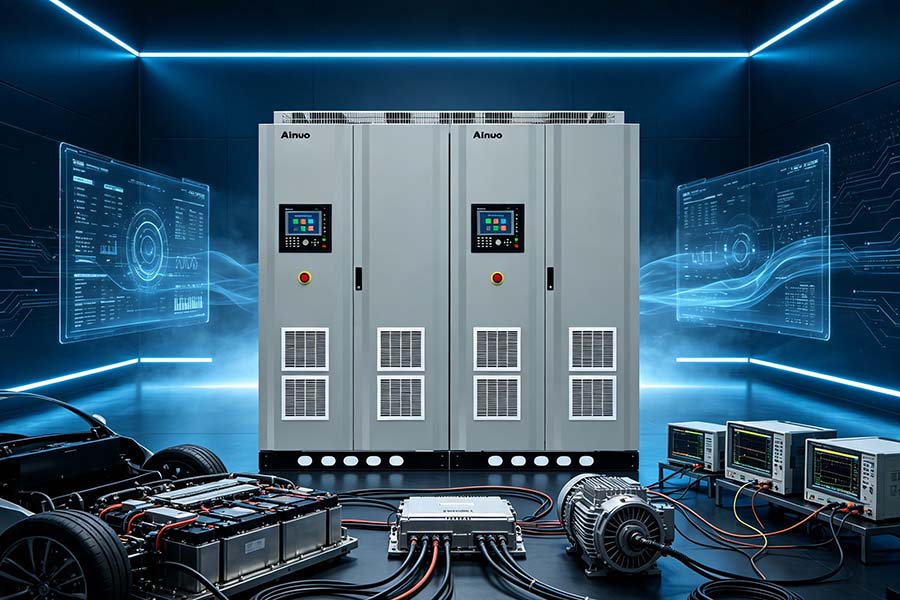
Modern battery simulators can model various battery chemistries and support bidirectional power flow, making them ideal for testing EV motors, inverters, on-board chargers (OBCs), DC/DC converters, battery management systems (BMS), and complete powertrain systems.
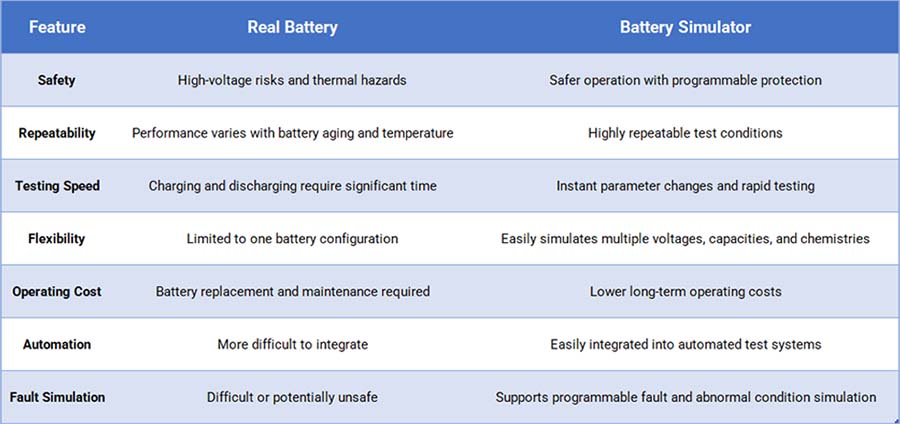
Real Battery vs. Battery Simulator
Advantages of Using a Battery Simulator for EV R&D
1. Improved Safety
Testing high-voltage battery packs involves risks such as overheating, thermal runaway, short circuits, and electrical shock. Battery simulators eliminate many of these hazards by replacing physical battery packs with controlled electronic sources.
This allows engineers to safely test extreme operating conditions without risking equipment damage or personnel safety.
Developers often need to evaluate hundreds of operating scenarios during product development.
With a battery simulator, engineers can instantly switch between:
These programmable transitions significantly reduce testing time compared with repeatedly charging or replacing physical batteries.
Real batteries degrade over time. Capacity fade, temperature changes, and cell imbalance introduce variables that make testing less consistent.
Battery simulators provide stable, repeatable output conditions, enabling engineers to compare results across multiple prototypes and software versions accurately.
Although a battery simulator represents an initial investment, it often reduces long-term testing costs by eliminating:
For organizations conducting continuous R&D, these savings can be substantial.
Many EV components must respond correctly to abnormal battery conditions.
A programmable battery simulator can emulate scenarios such as:
These tests are difficult—or unsafe—to reproduce consistently with real batteries.
When Should You Use a Real Battery?
Despite the advantages of simulation, physical battery packs remain essential for:
Battery simulators complement rather than replace physical batteries.
Best Practice: Combine Both Solutions
Leading EV manufacturers typically use a two-stage testing strategy.
Battery simulators are used for:
Real batteries are introduced for:
This hybrid approach combines the efficiency of simulation with the realism of physical battery validation.
Choosing the Right Battery Simulator
When selecting a battery simulator for EV applications, consider the following capabilities:
These features help ensure compatibility with modern EV development workflows and automated test environments.
Conclusion
For today’s EV R&D teams, battery simulators have become an essential testing tool. They provide a safer, faster, and more cost-effective alternative to physical batteries during most stages of product development while delivering highly repeatable and programmable testing conditions.
Real battery packs remain indispensable for final validation and certification, but relying on them exclusively can slow development and increase costs. By combining battery simulators with real battery testing, manufacturers can accelerate innovation, improve product quality, and bring new EV technologies to market more efficiently.
As electric mobility continues to advance, battery simulators will play an increasingly important role in enabling reliable, scalable, and efficient EV testing.
*Please fill in the required information carefully, and we will contact you within 4-8 hours.

 TEL:+86 532 83995188
 PHONE:+86 177 5322 5039
 E-MAIL:ainuo@ainuo.com
 ADDRESS:No. 134 Zhuzhou Rd, Laoshan District, Qingdao, China


Copyright©2025. Aino Instrument Co., Ltd All Rights Reserved.
Powered by:WDL